Monday, July 30, 2012

Research Update #5


On the last day of July,  I am at the starting blocks and now quite prepared for the 2012 breeding cycle.

The first of the known nesting pairs for 2012 has just hatched two eaglets, while another six pairs have gone down on eggs in the last couple of weeks.   From Ballito on the north coast, to Umdoni on the south coast, and as far inland as Howick, there are about 30 nest sites (some of which still need to be confirmed as still or recently occupied).  Out and about I have also seen several displaying pairs, and heard of other from reliable residents, that don’t coincide with current known territories.   Finding these nest sites will require a serious investment of searching effort.

as she rolls out of another loop - the female catches the sunlight on her underwing

look closely - it is amazing how flat and concealed such a large eagle can be

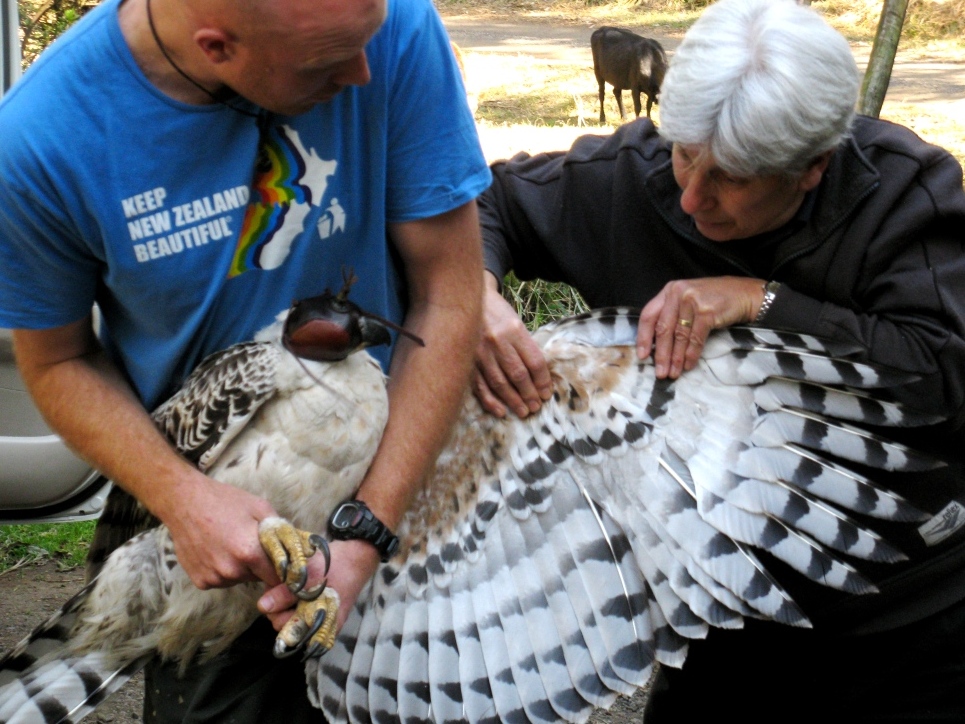
Lately with a little bit of self-justified ‘extra time’ on my hands (more accurately - a misdirected procrastination from drafting my introductory chapter) I have been out and about trapping some of the fledged juveniles from the 2011 cohort.  And had success with two birds, one in industrial Pietermaritzburg, and one in a rural residential area in Hilton.  While the sexes of most raptors are dimorphic, some Crowned Eagles appear quite marginal in their size – and it remains to be seen whether there is overlap between the smallest females and the largest males.  DNA sexing tests will provide unequivocal results – though in the meantime I have laid my bets based on some biometric information, and the behavior of the individuals.

The first two seemed quite catatonic in the hands, while my guess is the most recently caught was a male and a lot more coherent while being ringed - he tried to bite even while hooded.  Indeed he succeeded at one point, and managed to give me a very painful nip’l.


the third juvenile ringed  © Niel Rasmussen 


I find this particular observation quite interesting.  I am estimating from the moult pattern that this bird is about 20-22 months - a male that has found its ‘grown-ups’ voice.  This call is often heard when adults are sky-dancing over their territories either as courtship or as a territorial display.  So what is this guy up to?


Thursday, July 26, 2012

SAFA Field Meet 2012


The South African Falconry Association hosted the 2012 field meet earlier this month.  One year has passed since I first stepped foot in South Africa (in order to attend the 2011 meet) and the best thing was returning to this event and catching up with all the friendly and familiar faces.  As well as familiar faces, there were plenty of new faces to meet – this was the highest attending gathering of active falconers in South African history.

Falconers and spectators at SAFA Field Meet and AGM July 2012
There was a noticeable difference in the environment from the 2011 meet. The season has been a lot drier, which was most noticeable in the lack of small dams to fly duck over. It was therefore the task of the experienced duck falcons to fly over big water. The peregrines were therefore mostly flown at francolin, which seemed to be as abundant as or better than last year. The result of the drier autumn was very prominent in the maize fields, with the majority of crops harvested and large fields of stubble. Francolin coveys were readily seen on the edges of road and field, pecking away at the remaining corn kernels. The long grasslands held some numbers of quail and buttonquail, pleasing for the austringers – walking the field provided plenty of opportunities. 

Attending the field meet were representatives of Birdlife South Africa, and the Endangered Wildlife Trust. It is great to see the conservation organizations making good of these invitations and having open discourse about the impacts of falconers and falconry, and the practicalities of sustainable use. At the AGM I also learned of the intention of falconers to participate in the Animal Ethics certification courses, a very thoughtful intention.


A falconer is often walking the edge of chaos, managing the hawks weight fitness and motivation, managing the land and the quarry (gamebirds or waterfowl), and trying to find a setup where the bird has a decent chance of success.  Though one is never sure what might flush out from under foot – or whether the dog has a false point.  Non-target and rare species are sometimes in the wrong place at the wrong time, ending up as by-catch.  The ‘let lie’ rule allows the hawk to be fed up on the site of the kill (a fair reward), before being taken up.  The prey is then left in situ, rather than bagged. This dramatic photo of Ashton’s Black Sparrowhawk bearing down on a Bokmakierie is such an example of an unintended quarry flushing under the nose of a keen hawk.  


big sky country

trying to spot Tim Wagners stratospheric falcon