Saturday, December 15, 2012

The Empress' New Clothes

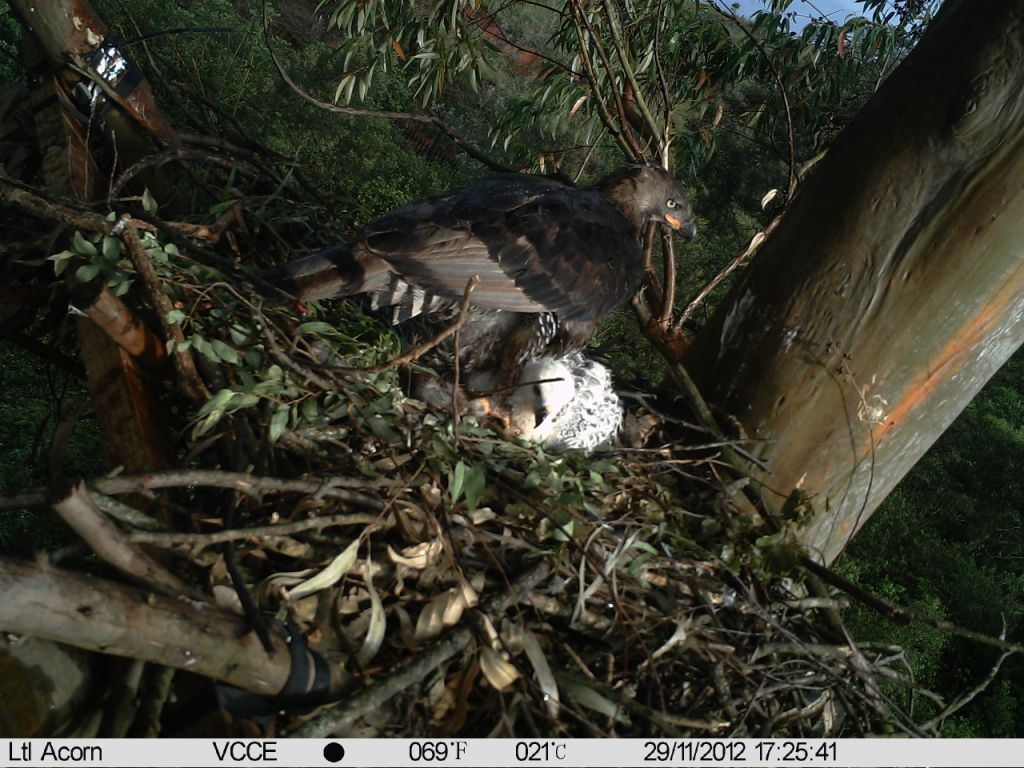
This sequence documents the development of the first pennate body feathers of Donna as her growth advances from 48 to 62 days of age.  Shown here with one photo around 5pm each day.

The first body feathers to develop are those of the scapulars and wing coverts.  These provide a level of waterproofing on the top surface that allows her to now sit alone on the nest through all weather.  Victoria is still doing all the feeding and regularly brings sprigs of gum leaves to keep the insects at bay, but now spends most of her time off the nest perched in nearby trees.  She is able to guard over her chick while also keeping an eye out for easy hunting opportunities.




Friday, December 7, 2012

eBirding December 2012

A huge growth in the number and variety of wildlife citizen science projects has developed in recent years.  Access to internet recording has increased the volume and ease at which one can provide data to these projects.

Southern Africa's portal is the Virtual Museum, serving as a platform to the mammalMAP, frogMAP, reptileMAP, echinoMAP, odonataMAP, and others. The bird atlasing project SABAP2 is the regions bird distribution database.  

For birding data I am an eBirder - which is largely responsible for my becoming somewhat obsessive about birding and checklists.  

eBird is well on the way to being the global repository of avian data.  I discovered this project, developed by the Cornell Lab of Ornithology, back in 2007 when it was just branching out of its USA origins.  Collaborating with OSNZ, a New Zealand portal was launched in May 2008 to modernize NZ atlasing, my accumulation of 1929 checklists since then has me amongst the most active of NZ ebirders.  These successful pilot expansions lead to the global launch in 2010.

The popularity of the project appears to be snowballing and in July 2012, eBird reached a pleasant round number of 100 million complete checklists. and over 2 million checklists received each month alone.  Over years and decades, these data can inform of abundance, population trends, migration timing, and shifts in distribution.  The variety of protocols makes it a flexible repository, and I particularly focus on Raptor Road Counts (Travelling counts) when driving long distances. Because eBird provides such varied feedback it can get a little addictive, and the Top100 rankings motivate the competitor in me.  

Here I've decided to highlight eBird on this blog, and post a 'big month'.  December is a busy field-based month for the eagle research, and while spending time in a variety of Durbans' nature reserves I anticipate a respectable list by new year.

Here is the first week of Decembers birding (sensitive locations have been blanked out): add-ons will be updated on this post throughout the month.


8 December

*correction - 161 Variable Indigobird   Vidua funerea  


That's the trouble with regional checklists - sometimes they dont match up with the global checklist that eBird uses.  So my Variable Indigobird is named Dusky Indigobird in Sasol fourth ed. to Birds of Southern Africa. It was also a complication experienced with the launch of the New Zealand checklist years back also.  Why do Kiwis persist in calling it a Spur-winged Plover, when infact there it is a lapwing from the Vanellus genus, the Spur-winged Lapwing is a African species, while the species that occurs in New Zealand is a Australian colonist, the Masked Lapwing. This rant is one I have subjected many friends to...

Therein is the explanation for the error above.  The beauty of eBird is I can quickly go back to the list, remove my mistake and add the correction.  Of course, if I hadn't there are also a number of moderators who email you if there is a out-of-range record. or other suspected error  ... I regularly get these kinds of emails to verify my sightings.


7 Jan 2013

I have just added the last update page to the eBirding big-month post.  It really tailed off there once we started ringing eagle chicks and trying to get gps transmitters on adults. But nonetheless 178 species for one month in Durban is still rubbing past my entire New Zealand life list of 170.  And in total this year, the South Africa list reached a grand total of 281 species (ranked 6th for the year and country), and 110 complete checklists (ranked 4th).